
The nanaco app earns you 1 point per 200 yen spent at 7-Eleven. That conversion rate sounds fine until you compare it to PayPay's frequent 1.5% cashback campaigns running through mid-2026.
A detail that shapes whether nanaco makes sense for you: the points only convert to spending credit inside the Seven & I Holdings network. Step outside that ecosystem, and your accumulated rewards sit frozen.
This article is for the foreign resident or long-term traveler in Japan who shops at 7-Eleven two or three times a week and wants to know if nanaco deserves a spot on their phone next to PayPay or Suica.
What Is nanaco and How Does It Work?
nanaco is a prepaid electronic money system owned by Seven & I Holdings, designed for tap-to-pay transactions at 7-Eleven and affiliated stores like Ito-Yokado and Denny's Japan.
You load money onto nanaco through the app, a linked bank account, a credit card, or a Seven Bank ATM. Then you tap your phone at checkout. The transaction clears in about two seconds.
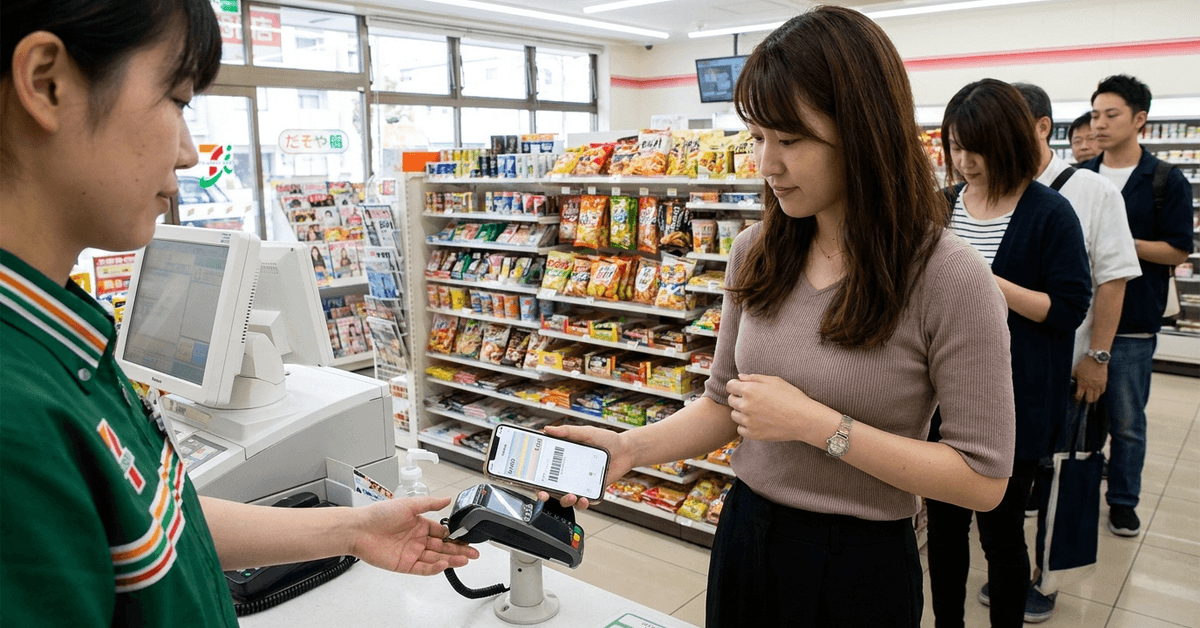
The app shows your balance, transaction history, and accumulated points in real time. That part works well. The friction comes later.
Loading Money Through the nanaco App
The reload process connects to Japanese bank accounts and some credit cards. App users can also scan a barcode at any Seven Bank ATM to add funds.
I would pick the ATM barcode method over credit card linking if you hold a non-Japanese credit card, because foreign card compatibility remains inconsistent as of early 2026.
Managing Multiple Cards on One Device
The nanaco app lets you register and manage several nanaco cards from a single phone. Families splitting household and personal spending across two cards can switch between them without carrying plastic.
nanaco Points: How the Rewards Break Down
nanaco's standard earning rate is 1 point per 200 yen spent on eligible purchases. Points accumulate automatically and appear on your app dashboard after each transaction.
Once you collect enough points, you convert them into yen credit. That credit spends at 7-Eleven, Ito-Yokado, and other partner stores. The conversion happens inside the app, though the menu path takes a few taps that first-time users may find confusing.
Seasonal Campaigns and Boosted Rates
Certain periods bring higher point multipliers, usually tied to new product launches or store anniversaries.
The app sends push notifications for these campaigns. Tracking them consistently is hard because the timing is unpredictable, and some campaigns target specific product categories only.
Birthday Bonuses and Member Offers
nanaco sometimes awards birthday points or member-only deals. Eligibility depends on your registration details being complete in the app.
Notifications for these bonuses tend to get buried, so checking the app's coupon section once a week is a reasonable habit.
nanaco vs Suica vs PayPay for 7-Eleven Shopping
Picking between these three depends on what else you do in Japan besides shop at convenience stores.
| Feature | nanaco | Suica | PayPay |
|---|---|---|---|
| 7-Eleven point earning | 1 pt / 200 yen | None (unless paired with JRE POINT) | Up to 1.5% cashback (campaign-dependent) |
| Train pass function | No | Yes | No |
| Accepted stores | Seven & I network + partners | Most transit and retail nationwide | Millions of merchants across Japan |
| Reload methods | Bank, credit card, ATM barcode | Bank, credit card, Apple Pay | Bank, credit card, ATM, convenience store |
PayPay covers far more merchants and often runs cashback campaigns that beat nanaco's fixed rate. Suica wins if you commute by train. nanaco earns its place only when your spending concentrates inside the Seven & I ecosystem.
I think the popular advice to "just pick one payment app and stick with it" misses how Japan's payment landscape works in practice.
Running PayPay as a primary wallet alongside nanaco for 7-Eleven purchases gave me a consistently better return per yen than committing to either app alone, based on the 1.5% PayPay cashback campaigns versus nanaco's flat 0.5% rate across Q1 2026.
Using nanaco for Tax and Utility Bill Payments
Some municipal offices and utility providers allow bill payment through nanaco at 7-Eleven registers. The app does not process these payments directly. You bring the paper bill to the store and pay at the counter using your nanaco balance.
Two things to watch:
- Eligible bills vary by municipality. A bill payable via nanaco in Tokyo may not be payable in Osaka. Check the barcode on your bill or ask the cashier.
- Point earning on bill payments is restricted. Certain tax payments and utility bills do not earn nanaco points even though you can pay with nanaco balance.
- Balance limits apply. The maximum nanaco balance is 50,000 yen. A large utility bill could push you right up against that ceiling.
The Language Problem for Non-Japanese Users
The nanaco app's interface is primarily in Japanese. 7-Eleven and Seven & I Holdings have added limited English support on some screens, but error messages, customer support chat, and detailed settings pages remain Japanese-only as of 2026.
Google Translate's camera mode handles most menu screens reasonably well. But if something goes wrong with a transaction or a reload fails, troubleshooting through Japanese-only support channels gets frustrating fast.
For non-Japanese speakers planning to use nanaco longer than a few weeks, I would bookmark the nanaco official FAQ page and run it through a translator before you need it.
What Happens to Your Balance When You Leave Japan?
nanaco has zero international acceptance. Your remaining balance stays trapped on the card or app once you leave the country. There is no cash-out feature and no refund process for app-based balances.
The smart move: spend down your balance before your departure date. Buy gift cards, stock up on snacks, or pay any eligible bills. Leaving money on nanaco after your flight is the same as throwing it away.
Budgeting and Everyday Uses Beyond Payments
nanaco's prepaid structure creates a natural spending cap. You can only spend what you load. That constraint appeals to people who want to control their convenience store budget without relying on willpower alone.
Some parents in Japan use nanaco cards loaded through the app as a controlled allowance for teenagers. The app's transaction history lets you see exactly where the money went.
The gifting angle works too. Load a nanaco card with a set amount through the app and hand it to someone. Quick, practical, and useful at any 7-Eleven in the country.
Questions People Ask About the nanaco App
A few common searches about nanaco that deserve quick answers.
- Q: Can I use the nanaco app on an iPhone and Android?
The nanaco app is available on both iOS and Android. iPhone users need iOS 15 or later and an Apple Pay-compatible device. Android users need a phone with NFC and the osaifu-keitai (mobile wallet) function, which rules out some non-Japanese Android models. - Q: Does nanaco work outside of 7-Eleven?
Yes, at Ito-Yokado, Denny's Japan, some Esso gas stations, and several other Seven & I partner stores. Coverage at independent shops is rare. Do not expect the same acceptance range as PayPay or Suica. - Q: Can tourists get a nanaco card or use the app?
Tourists can buy a physical nanaco card at any 7-Eleven for 300 yen. The app requires a Japanese phone number for full registration, which limits functionality for short-term visitors using foreign SIMs. - Q: Is there a fee for using nanaco?
No transaction fees for purchases. The physical card costs 300 yen to issue. The app is free to download and use. Reloading from a credit card may carry fees depending on your card issuer. - Q: How do I check my nanaco balance without the app?
Ask the cashier at any 7-Eleven register, check at a Seven Bank ATM, or look at the receipt from your last nanaco purchase. The balance prints automatically.
Conclusion
The nanaco app fits a specific type of shopper in Japan: someone loyal to 7-Eleven and the Seven & I chain. Stacking it alongside a broader payment app like PayPay covers gaps that nanaco leaves open.
Draining your balance before leaving Japan is a step too many people skip. And if you read Japanese or have a good translation tool, the app rewards consistency over time.